

Three-Step Sparring (Sanbon Kumite)
A 3rd Dan black belt stands beside me and my opponent. “Hajime!” he commands. Start!
I drop into Zenkutsu Dachi (front stance) with a Gedan-Barai (downward block). “Hai!” My shout is a kiai, a focussed, explosive cry meant to focus physical energy with mental intent and (with any luck) startle my opponent. “Jodan,” I announce.
“Osu,” my opponent acknowledges.
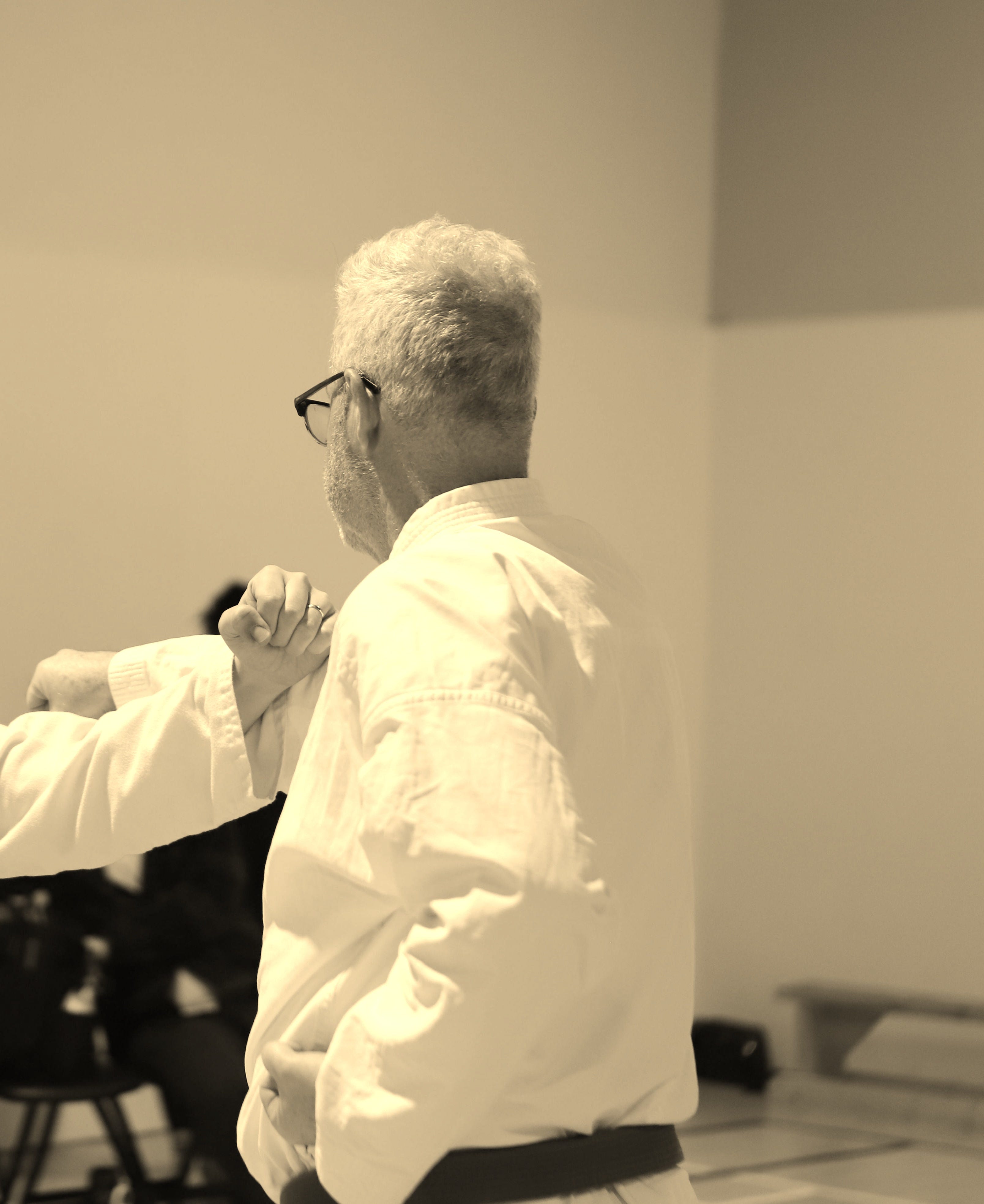
Even though I like this guy, I step forward to punch him in the head as hard as I can with a tsuki jodan (head-level punch).
He blocks me with an age-uke (rising block). I step forward to punch him again, right in his face. Again, he successfully blocks me. I do it a third time, he blocks me a final time, but now he punches back, at my chest level (chudan level), his fist stopping an inch before my actual chest.
Then we do it all again. This time he tries to punch me while I block. And we go back and forth one more time punching at chest level. It’s called three-step sparring, or Sanbon Kumite in Japanese. It’s the most basic kind of sparring you do in Shotokan Karate. We’re not actually supposed to hit another. We’re just demonstrating the proper form in front of several judges and spectators and other competitors. But we are trying to do it better than one another because we’re competing, and each of us would like to win.
We finish and bow to one another. The judges raise their flags, indicating that I’ve won this round. Which is good; it would have been embarrassing had I lost because I’d been paired with a white belt because he had nobody else to compete with at his level. But I could have lost, because he is younger than me, fit, and really good for his level; he will rise through the kyu ranks quickly.
You Can’t Fail
We’re competing in the adult division of the 2026 ISKF New Brunswick Invitational Tournament, hosted by the Moncton Chapter of the International Shotokan Karate Federation. I’m a 5th kyu blue belt, and although I’ve trained elsewhere before, this is the first Karate tournament I’ve ever competed in. And as I stand there beneath the gymnasium’s bright lights, with referees barking orders and close to one hundred other karateka of all ages competing before several dozen spectators, I think: this is really cool.
It’s cool because it’s such a great experience for all the kids attending; many, like me, participating for the first time. It’s cool because it began with a black belt grading that many of us got to watch, presided over by an 8th Dan from Halifax, Sensei Tony Tam. And it’s cool because after the grading Sensei Tony delivered a seminar for many of us, assisted by several other black belts from his dojo. I’ve never seen so many black belts adorned with belts faded almost to white. For the belts of these karateka to be so worn suggests a lifetime devoted to the practice of Shotokan Karate.
“You’re probably nervous,” Sensei Tony told the brown belts grading to become 1st Dan black belts. “But you don’t need to be. You can’t fail. The only way you can fail at karate is if you stop training.”
Some of us watching the grading found it terrifying. Sensei Tony asked those grading to do things a little differently than they’d been practising. This meant they couldn’t rely on muscle memory. They had to think on the fly. They had to do so in front of Sensei Tony, the one evaluating them, and in front of the rest of us, with whom they’d be training — and in many cases, teaching — later. No doubt they considered their credibility on the line. Many observing, including me, knew — or hoped — we’d have a chance to grade to black belt ourselves one day. It did not look like a relaxing experience.
Happily, everyone passed, and Sensei Tony promoted them all right then and there in front of us, and we could not have been more pleased for our fellow karateka.
Knowing that I’d be competing later, one of the kids asked me if I was nervous. “Not really,” I told her.
The stakes weren’t especially high for me. As one of the official YMCA volunteers, I was there to support the dojo, help out if called upon, and experience a tournament for the first time. It certainly didn’t matter to me whether I won a medal. Mainly, I didn’t want to embarrass myself. “Pretty low bar,” my own sensei said when I told him that.
After which I decided to aim maybe just a bit higher.
The problem was the possibility of embarrassing myself was all too real. As a kid, I was never great at sports. I remember missing a pass in an important hockey game when I was about ten that still makes me cringe whenever I think of it. I’m not especially fond of performing katas or choreographed kumite (sparring) with other people watching. Sometimes my brain glitches and I mess things up. When it happens, it’s embarrassing.
A Warm Glow
But at sixty-one years old I’ve experienced enough embarrassment in my lifetime to know that it’s a part of life. You get over it. And by now I’ve had enough successes to offset those embarrassments. For instance, I have another core memory of performing a trombone solo in a high school jazz band competition in front of famed trombonist Rob McConnell. Evaluating our performance, McConnell singled out my solo. “It was a bit loud,” he told everyone present, “but otherwise pretty good.” Everyone applauded, and our jazz band got a bronze medal. I was happy I hadn’t let everyone (and myself) down, and that success has accompanied me through life, providing a tiny but perceptible warm glow whenever I need to draw upon it for strength
So the truth was, I wasn’t ALL that nervous, but I was a LITTLE nervous.
I tried not to think about it. Which wasn’t hard because I was really enjoying myself. I admired everything about the tournament, which a handful of our volunteers had organized. They had secured the venue, acquired sponsorships, organized the schedule, planned the competitions, and sorted out the logistics, all the while participating themselves, performing admirably in the gradings and competitions. It must have been extremely stressful for them, but they did it all with the kind of good cheer that reaffirms your faith in humanity.
The Kata
Just before the three-step sparring, I had competed in the adult kata competition. I chose Heian Godan, which is the kata I’ve been focussing on the last six months. A couple of people have told me they consider it one of the hardest of the kyu-rank katas. It definitely is a challenge; it’s taken me forever to get it even close to what it’s supposed to be. I was always leaning too far forward or getting the stances wrong.
So Heian Godan became the first kata I ever performed in a karate tournament.
Fortunately, my brain didn’t glitch. Muscle memory served and I got through it without messing it up. Still, I felt it got off to a rocky start, my stances about as stable as a newborn foal. I have a lot of trouble getting Kokutsu-dachi (back stance) correct consistently. I didn’t feel like I got in the groove until the first Gedan Juji-uke (low cross block). Afterward the judges awarded me 6.1. 6.1, and 6.2. I didn’t turn around to see what the judges behind gave me (it seemed disrespectful to do so), but it was probably 6.1 and 6.2 because (if I understand the scoring properly) the highest and lowest scores are discarded and the rest are added up, and I scored 18.4 (I think). I was disappointed but it could have been worse.
Afterward I thanked the judge who gave me the 18.2. “You were generous,” I told him.
“You were stiff and a bit rushed,” he told me. “Also, you were the first to compete, which is tough. Judges always score the first competitor low so they have headroom for the ones who come later, in case they do really well.”
Suffice to say, I didn’t medal in the kata competition.
One-Step Sparring (Kihon Ippon Kumite)
Next up was one-step sparring, similar to three-step sparring except you only take one step forward. And accompanying the two punches are three kicks: Mae-geri (Front Kick), Yoko-geri Kekomi (Side Thrust Kick), and Mawashi-geri (Roundhouse Kick). As well, you have to include a kick of your choice in your defense along with at least two other strikes. (I didn’t get to compete in free sparring, which is more like actual fighting — and what you might be familiar with from movies like Karate Kid — cuz I’m not quite advanced enough yet.)
Now, I know how to do one step sparring, I’ve done it enough in class. But this time my brain did glitch. I blocked with the wrong arm on the Mae-geri and again, amazingly, on the Kekomi, after which it was game over. My opponent won, deservedly.
I had one more match. Fortunately, I managed not to screw that one up, and came away with a bronze. This was a pleasant surprise, considering I hadn’t expected any medals at all.
“I won a medal,” I told one of my daughters later.
“You beat up some kids for that?” she asked me.
“No, I did not beat up any kids,” I informed her. “It’s not like that Seinfeld episode.”
I’m not sure she believed me.
Follow Joe Mahoney and Donovan Street Press Inc. on: Goodreads, Bluesky, Threads, Mastadon, Facebook, and Instagram
Great piece. That’s my Halifax club, and my Sensei of 30-plus years—Tony Tam—who keeps me forever learning.